

👨👩👧👦 Educational family activity: learning while having fun with your children
Why do educational activities as a family?
Learning isn't limited to school. At home, in a relaxed and loving environment, children are often more receptive, especially if learning is done through play. Educational activities at home help develop key skills (language, logic, creativity, scientific curiosity) while creating genuine moments of sharing.
Here are 6 ideas for educational activities to do together, to learn in a different way.
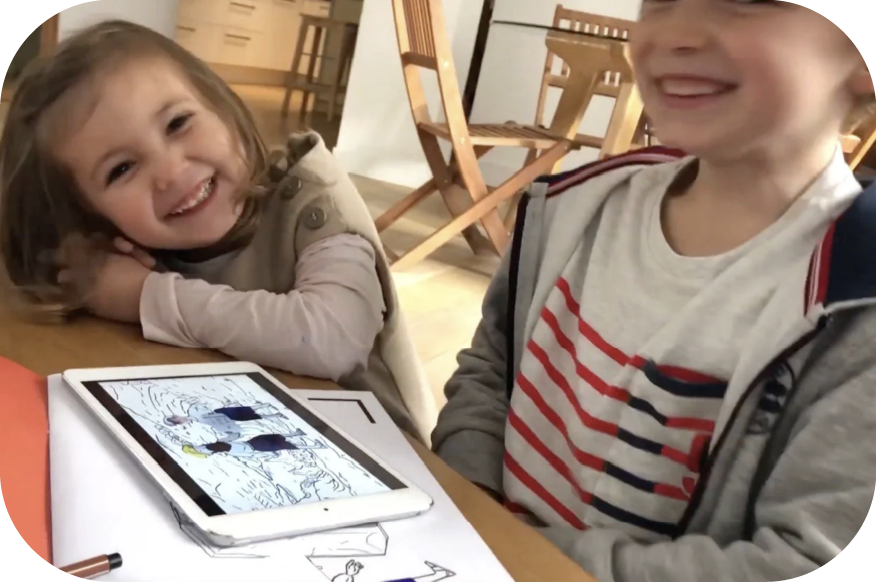
📚 1. Color, scan, learn with BlinkBook
Materials: BlinkBook notebook (science, dinosaurs, stories…), pencils, BlinkBook app
Duration: 30 to 45 minutes
The principle is simple: your child colors an educational scene (for example, the human body or the world of dinosaurs), then scans it to see it come to life. The animation tells a mini-story full of knowledge.
👉 Parent tip: watch the animation together, then ask questions: “Do you remember what this cell is called?” This reinforces memorization in a fun way.
🌍 2. Create a relief world map
Materials: cardboard, salt dough or papier-mâché, paint
Duration: 1.5 to 2 hours
Represent the continents and oceans, and place the iconic animals of each region. A great way to talk about geography, wildlife, and ecology.
👉 Parent tip: tell an anecdote about each country visited or dreamed of to make the activity even more lively.
💰 3. Playing shopkeeper (educational version)
Materials: labels, fake money, empty boxes
Duration: 30 minutes to 1 hour
A perfect activity for learning to count, recognizing numbers, doing simple additions and understanding the concept of exchange.
👉 Parent tip: play the role of the demanding or distracted customer: your child will have to think, adapt, argue.
🧪 4. Conduct a simple science experiment
Examples: volcano with baking soda and vinegar, homemade modeling clay, salt crystals
Duration: 15 to 30 minutes
Experiments at home are easy to organize and always impress children. In addition, they awaken their logical and scientific thinking.
👉 Parent tip: Simply explain each step and encourage the child to make hypotheses: “What do you think will happen?”
🧩 5. Create a custom memory game
Materials: cardstock, photos or drawings, scissors
Duration: 1 hour (creation + play)
Create a memory game together using your photos, drawings of animals, or objects. The child learns to concentrate, visualize, and memorize.
👉 Parent tip: offer several levels of difficulty (6 cards, 12, 24...) to follow the development of their abilities.
🖼️ 6. Museum visit at home
Materials: internet, screen, children's art books
Duration: 30 minutes
Take a virtual tour of a famous museum (The Louvre, Musée d'Orsay, Natural History Museum, etc.). Then, recreate together the artwork that your child liked the most.
👉 Parent tip: print the chosen artwork, and propose a “copy challenge” or a modified version (e.g., Mona Lisa skateboarding).
Conclusion :
An activity is considered “educational” when it awakens, stimulates, and transmits knowledge, but it can (and should!) also be enjoyable. Learning as a family not only reinforces your child's knowledge but also creates a lasting bond of trust and cooperation.